
Post #13: Bye for now, Brazil
What we know is this: all things in life come to an end. I leave Florianópolis today with mixed feelings—excitement at seeing my loved ones in Toronto, sadness at stepping off this “island of magic”—and a full heart.
It is said that Floripa either embraces or expels people. It was my good fortune to have the city embrace me in a tight grip, to offer me endless adventures, and to place a cast of delightful characters along my path. I marvelled at, and at times felt undeserving of, all the warmth and welcome I received.
Perhaps not all of it was luck. Learning Portuguese gave me a ticket to the local residents’ lives, to their hopes and fears and frustrations with their own country. While my initial goal of “sounding like a native” proved overambitious, I was able t o understand and make myself understood, to share laughter and tears with my friends, and even to tell a few bad jokes.
Taking social risks also helped. I cast wide nets online, invited people for coffee after fleeting exchanges in stores or on hikes, and approached a local musician after his set—a gambit that culminated in a private concert on my back porch. Just about all my overtures were met with interest and several led to friendships.
There were challenges, to be sure. I learned that “venha jantar com a gente, quando quiser!” did not mean an actual dinner invitation was forthcoming. Along similar lines, the cultural tic of leaving plans to the very last minute, and then cancelling said plans due to a father’s birthday or a sick dog, caused me all manner of frustration. In time I came, if not to love this aspect of Brazilian culture, to roll with it and tease my friends about their flakiness.
Like all great trips, this one was above all a journey of self-discovery. I discovered that I could deal with bank machines that sometimes accepted my credit cards and sometimes did not, a public transport system that often left hour-long gaps between buses, and engarrafamentos that made Toronto’s traffic look like an Indy 500 race, without my customary first-world impatience. I discovered that I don’t need much material comfort to be happy. Living in a 12’ x 12’ apartment, washing clothes by hand witho ut hot water, shooing away the occasional cockroach—none of this put a dent in my mood.
Above all, I learned that age does not place hard limits on what a person can dream and do. (Well, that’s not quite true. I can confidently state that I will never ride a surf board amid Floripa’s crashing waves.)
Through all my adventures, I never lost sight of my husband and children, who understood my need for this trip and cheered me through it. I also drew strength from my two Brazilian friends in Toronto, whose support blasted through the miles between us.
I plan to come back someday, possibly with my family. But I will not attempt to repeat an experience that, by its very nature, can only happen once. And that shines all the more brightly for having a finish line.
Thanks for reading. To leave a comment, scroll to the bottom and type in the box.

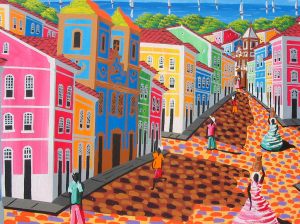 And so it was with Salvador, the “jewel of the northeast.” It was everything my friends had promised. And more. And less. The people were indeed friendly, but it was hard to roll with the chumminess of the cab driver who kept calling me bonita while casting me sidelong glances. The city was indeed colourful, but the colour seemed interwoven with its poverty: the candy-hued façades in need of a good scrubbing, the print dresses of the sweaty women serving aracajé in miniature kiosks, the bangles and tote bags of the street vendors who began their pitch with various versions of “I live in a favela and have eight children…”
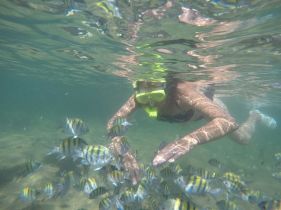 I had two problems: no cell phone and a bad mood,” he said. “Instead I chose to stay happy, so I only have one problem.” Note to self: remember this convo the next time I’m on the phone with Bell Canada.
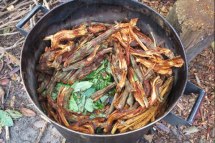 ual. Some people call the herb “mother aya” and say things like “mother aya will give you not what you want, but what you need” or “mother aya has wide, caring arms and never judges.”
 f minutes, everything seemed right with the world.
 for a driver called Marcos, recommended by her former employer, to pick me up at the airport. As we sped along the linha vermelha, the rising sun bringing the favelas into focus, I got ready to duck so I could dodge the bullets, but the street gangs were apparently taking a breakfast break.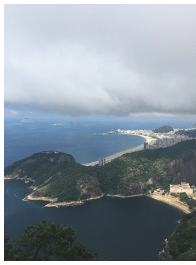
 Ya Ya made me a caipirinha with cachaça rum, limes, and acerolas from her garden. It wasn’t quite noon yet, and I only drink before noon during long layovers at airports, but hey, this was Carnaval. Que comecem os trabalhos, as people say around here. Let the work begin.
 g and dancing and waving their raised arms like windshield wipers.
 l appreciation” side of the debate—and who loved Oliveira in the soap opera O Profeta—I found this more than a little disconcerting.
 “Coming right up,” I felt like saying. “Just hang on while I retrieve my walker and pop in my hearing aid.”
 ilian fruits all over the house and I got to try them all: maracujá, guaraná, cupuaçu, goiaba, abacaxi, their tastes as exotic as their names.
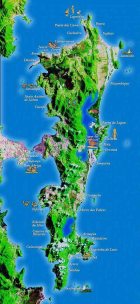 Floripa) is a state capital and has close to half a million people, it’s more a collection of small towns than a standard city, thanks to said mountains. With forty-two gracefully curved beaches, a salt-water lagoon, sand dunes, one of Brazil’s largest universities, restaurants to suit every palate, flashy bars, and old fishing villages dating from colonial days, the island has enough variety to sustain a lifetime of exploration.
 even though my Spanish was more than rusty and everything I said came out as Spantuguese. As it turned out, I still knew enough of the language to fend off an old man (you know, someone in his sixties) who insisted on showing me “the great view” from his apartment.
 This wouldn’t have happened to me at thirty. Or forty. Or fifty-nine. There’s no escaping it: it’s the beginning of the big biochemical blowout, the synaptic switch-off, the slide into vacant-eyed oblivion. By the time I get to Brazil I’ll probably have no words left, just chin hairs and missing teeth.
 packaging and settled in for a good brain sweat. And then I read the first sentence: “Professor Dr. Moritz-Maria von Igelfeld often reflected on how fortunate he was to be exactly who he was, and nobody else.” This was not a book about Portuguese irregular verbs, this was a novel. Oops.
 When he wasn’t writing treatises, Professor von Igelfeld spent his time flitting from one conference to another, where the four or five people who attended his lectures hung on to his every word. Wherever he went, disaster followed: he ordered the wrong dish, offended a hotel clerk, or missed a chance to marry a woman because his best friend proposed to her a day earlier. Never one to dwell on might-have-beens, Professor von Igelfeld took solace in the thought that his magnum opus would grace scholars’ bookshelves long after his death. By the end of the book, I wanted to give the guy a hug.
 would clear up my confusion. If nothing else, I hope that a philologist just like him will one day write a book just like his, though I’m not sure 1,200 pages would cover the topic.
 Gabrielle Bauer